

DNR65231-VC1
Single-Channel Ultra-Low Latency AI Deep Noise Reduction Processor with Integrated USB and I2S Interface
1. Introduction
1.1 Product Description
DNR65231 is a high-performance AI deep noise reduction product based on XMOS processor architecture, designed to provide exceptional audio processing capabilities for audio equipment manufacturers. The product integrates two independently optimized AI noise reduction models.
- The strong noise reduction model employs a deep neural network architecture, capable of effectively processing various stationary and non-stationary noises in complex acoustic environments, achieving maximum noise suppression while ensuring high fidelity voice restoration
- The singing noise reduction model reduces processing latency to 11 milliseconds through lightweight design, effectively suppressing background noise while completely preserving vocal characteristics.
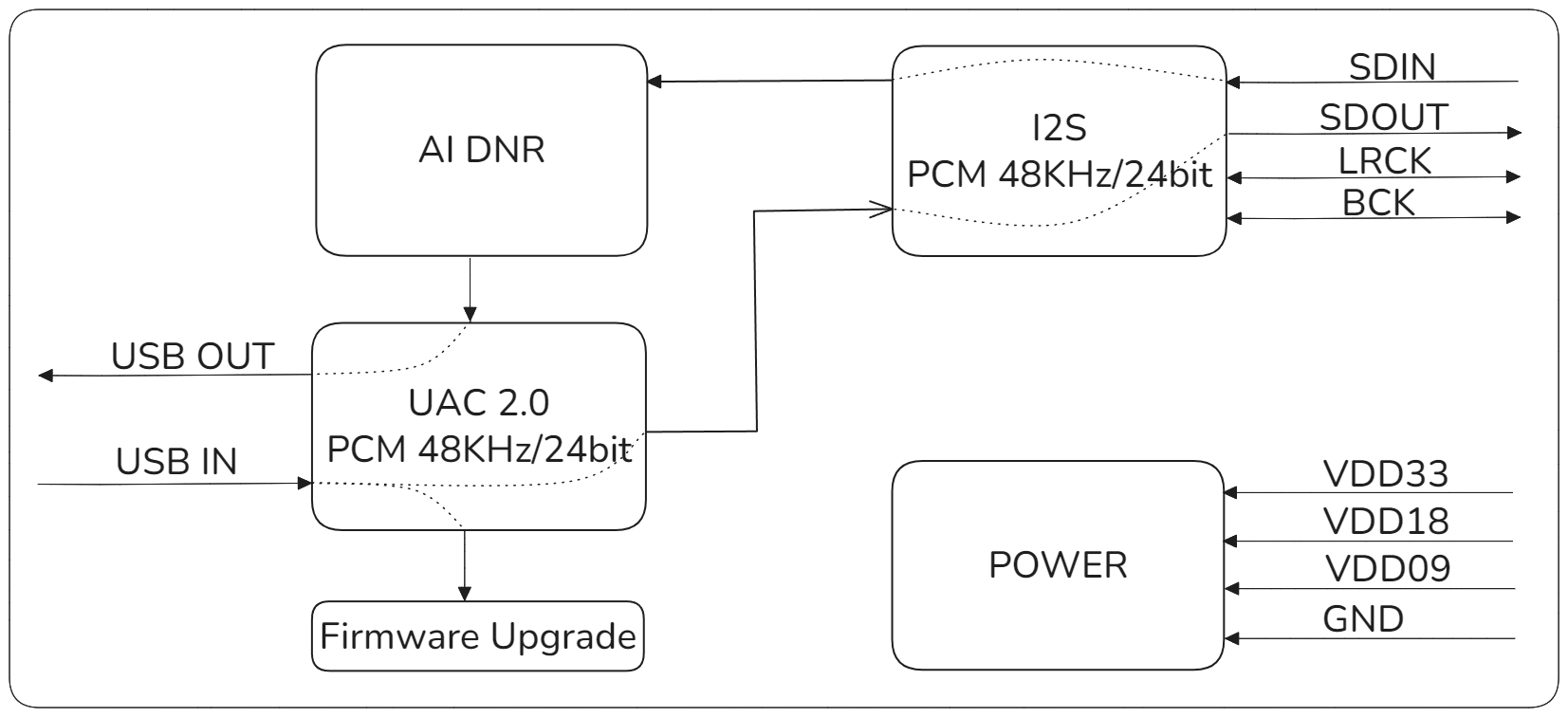
- The product supports I2S audio input with USB output capability, and also supports USB audio output to I2S, widely applicable to live streaming equipment, conference systems, recording devices, outdoor sports DV cameras, and many other application fields.
1.2 Product Features
Audio Performance Features
- AI Deep Noise Reduction
- Eliminates various stationary and non-stationary noises, adapting to complex acoustic environments
- Effectively eliminates sudden noises such as key presses, keyboard clicks, and footsteps
- Dual AI Noise Reduction Models
- Strong noise reduction model suitable for complex acoustic scenarios: outdoor recording, gaming, and other scenes
- Singing noise reduction model suitable for indoor live singing or interview scenarios
- Ultra-Low Latency Real-Time Processing
- Strong noise reduction model latency < 50ms, meeting audio-video synchronization requirements
- Singing noise reduction model latency < 11ms, meeting strict live singing requirements
- High-Fidelity Voice Restoration
- Strong noise reduction model completely preserves voice characteristics
- Singing noise reduction model not only completely preserves voice characteristics but also retains the trailing tones in singing
USB Interface Features
- Supports UAC 2.0
- Supports OTG connection
- Plug-and-play, no driver installation required
- Supports HID configuration
System Compatibility
- Supports multiple operating systems including Windows, Linux, Android, macOS, and iOS
- No special driver installation required
1.3 Application Scenarios
- Live Streaming Equipment
- Effectively suppresses various environmental noises, adapting to diverse live streaming scenarios
- Gaming Headsets
- Eliminates keyboard sounds, mouse clicks, and background noise, providing clear teammate communication experience
- Outdoor Sports Equipment
- Suppresses wind noise and environmental noise interference in sports scenarios, providing clear call and recording experience for outdoor sports enthusiasts
- Outdoor Recording Equipment
- Achieves high-quality recording in complex outdoor acoustic environments, meeting professional needs for on-site interviews and content creation
- Conference System Equipment
- Processes background noises such as air conditioning sounds and footsteps in office environments
- Communication Equipment
- Communication equipment suitable for business calls with strict real-time requirements, providing imperceptible latency voice processing experience
1.4 Product Functional Block Diagram
1.5 Ordering Information
| PRODUCT MODEL | ORDERING NUMBER | PACKAGE BODY | SIZE (NOM) | Hardware Model | Comments |
|---|---|---|---|---|---|
| DNR65231-VC1 | DNR65231-VC1 | SMT LGA-52 | 13x13mm | A316-Mini-V1 | Single-Channel Ultra-Low Latency AI Deep Noise Reduction Processor with Integrated USB and I2S Interface |
2. Modes and Specifications
2.1 Supported Input/Output Modes
| Mode Number | Input/Output Mode | Description |
|---|---|---|
| 1 | I²S In(Master) → AI DNR → USB(UAC2.0) USB(UAC2.0) → I²S Out(Master) | Supports I²S input with AI DNR noise reduction and USB output, as well as USB input with I²S output |
2.2 Detailed Parameters for Each Operating Mode
2.2.1 USB(UAC2.0) ←→ I²S(Master) Mode
Input/Output Parameters:
| Parameter | Input/Output | Input/Output |
|---|---|---|
| Interface | USB Audio Class 2.0 | I²S(Master) |
| Audio Format | PCM | PCM |
| Sample Rate | 48KHz/24bit | 48kHz/24bit |
| Bit Depth | Fixed 24bit | Fixed 24bit |
2.2 Noise Reduction Performance Comparison
| Comparison Dimension | Strong Noise Reduction Model | Singing Noise Reduction Model | Traditional Noise Reduction Technology |
|---|---|---|---|
| Technical Principle | Deep neural network architecture, AI algorithm for real-time spectrum feature analysis, intelligent voice and noise component identification | Optimized specifically for music scene processing based on the strong noise reduction model, preserving singing pitch and timbre characteristics | Frequency domain filtering methods based on statistical models and fixed algorithm parameters |
| Processing Latency | < 50ms, meets audio-video synchronization requirements | < 11ms, ultra-low latency | Medium latency |
| Noise Processing Capability | Effectively processes stationary and non-stationary noises | Specially optimized for music content processing | Limited capability in handling non-stationary noises |
| Voice Fidelity | Completely preserves voice characteristics | Completely preserves the trailing tone details in singing | May experience audio quality loss |
| Environmental Adaptability | Processes various complex acoustic environments | Specially optimized for music scenarios | Suitable for relatively stable acoustic environments |
| Typical Applications | Outdoor live streaming equipment, gaming headsets, conference systems, professional recording equipment | Indoor live streaming equipment, karaoke equipment, music recording, online interview systems | Traditional telephone systems, basic conference equipment, basic audio processing |
3. Pin Configuration and Functions
3.1 DNR65231_VC1 Pin Layout

3.2 DNR65231_VC1 Pin Description
| Pin Number | Name | Type | Function |
|---|---|---|---|
| 1 | 3.3V | P | Module 3.3V power supply |
| 2 | X1D13 | I/O | NC |
| 3 | X1D16 | I/O | NC |
| 4 | GND | P | Module ground |
| 5 | X1D17 | I/O | NC |
| 6 | X1D18 | I/O | NC |
| 7 | X1D19 | I/O | NC |
| 8 | X1D22 | I/O | NC |
| 9 | X0D29 | I/O | Active low Low noise level LED indicator Slow blink: Singing noise reduction model Solid: Strong noise reduction model |
| 10 | X0D35 | I | I²S_IN_BCLK(MASTER) |
| 11 | X0D36 | I | I²S_IN_LRCK(MASTER) |
| 12 | X0D37 | I/O | I²S_IN_DATA0(MASTER) |
| 13 | X0D38 | O | I²S_OUT_DATA0(MASTER) |
| 14 | X0D40 | I/O | Active low Short press: Cycle through noise reduction levels: Off, Low, Medium, High Long press: Switch noise reduction model |
| 15 | X0D39 | I | I²S_OUT_MCLK(MASTER) |
| 16 | X0D42 | I/O | Microphone MUTE_SW, active low |
| 17 | X0D41 | I/O | NC |
| 18 | X0D43 | I/O | NC |
| 19 | X1D34 | I/O | NC |
| 20 | GND | P | Module ground |
| 21 | X0D30 | I/O | Active low Medium noise level LED indicator Slow blink: Singing noise reduction model Solid: Strong noise reduction model |
| 22 | X0D31 | I/O | Active low High noise level LED indicator Slow blink: Singing noise reduction model Solid: Strong noise reduction model |
| 23 | X0D32 | I/O | NC |
| 24 | X0D33 | I/O | NC |
| 25 | GND | P | Module ground |
| 26 | GND | P | Module ground |
| 27 | GND | P | Module ground |
| 28 | X0D00 | I/O | USB detection - connected to VBUS 3.3V divider |
| 29 | X0D11 | I/O | USB status indicator High level (USB connected) Low level (USB disconnected) |
| 30 | X1D00 | I/O | NC |
| 31 | X1D01 | I/O | NC |
| 32 | GND | P | Module ground |
| 33 | X1D09 | I/O | NC |
| 34 | X1D10 | I/O | NC |
| 35 | X1D11 | I/O | XU316 internal clock output, connected to X0D39 |
| 36 | GND | P | Module ground |
| 37 | GND | P | Module ground |
| 38 | TDI | I/O | XTAG debug PIN |
| 39 | TDO | I/O | XTAG debug PIN |
| 40 | TMS | I/O | XTAG debug PIN |
| 41 | TCK | I/O | XTAG debug PIN |
| 42 | RST_N | I/O | System reset, active low |
| 43 | 1.8V | P | Module 1.8V power supply |
| 44 | GND | P | Module ground |
| 45 | USB_DM | I/O | USB_DM |
| 46 | USB_DP | I/O | USB_DP |
| 47 | GND | P | Module ground |
| 48 | 0.9V | P | Module 0.9V power supply |
| 49 | GND | P | Module ground |
| 50 | GND | P | Module ground |
| 51 | GND | P | Module ground |
| 52 | GND | P | Module ground |
Pin Type Description
I/O type definitions in table: I=Input, O=Output, P=Power, I/O=Input/Output
4. Hardware Parameters
4.1 Normal Operating Conditions
| Function | Minimum | Typical | Maximum | Unit |
|---|---|---|---|---|
| Operating Temperature | 0 | - | 70 | ℃ |
| 3.3V Operating Voltage | 3.0 | 3.3 | 3.6 | V |
| 1.8V Operating Voltage | 1.62 | 1.80 | 1.98 | V |
| 0.9V Operating Voltage | 0.855 | 0.90 | 0.945 | V |
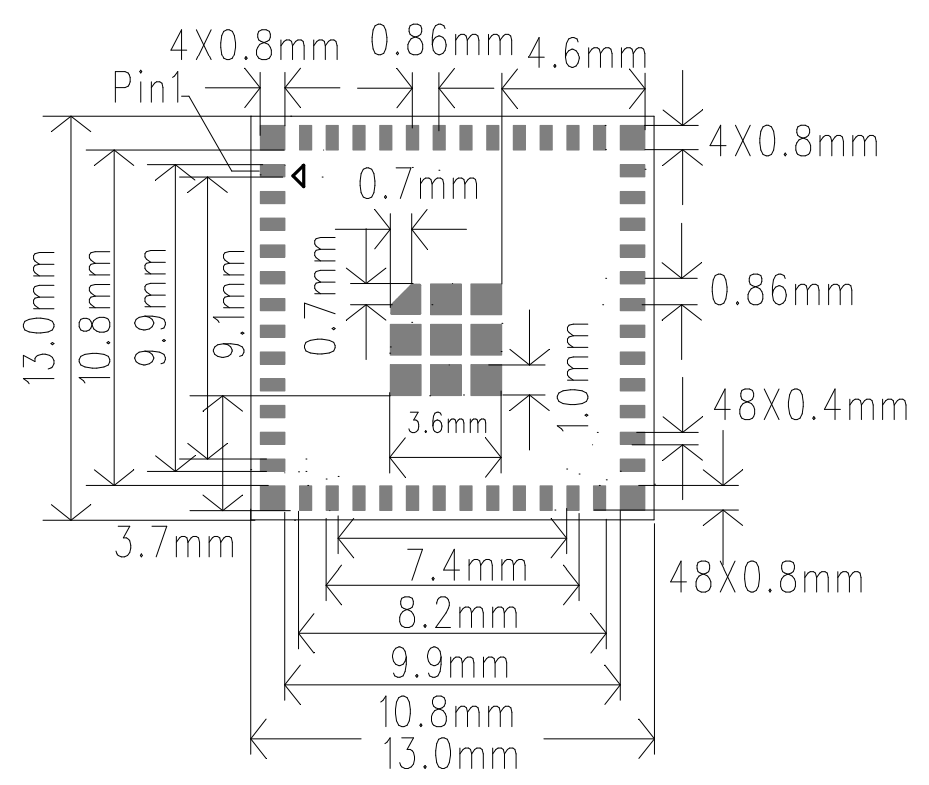
4.2 Product Dimensions
13±0.1mm(L)X13±0.1mm(W)X0.8±0.1mm(H)
4.3 Module Package Diagram
5 Product Packaging Information
Tray + Outer Box Packaging
6. Revision History
| Version | Date | Description | Revised By |
|---|---|---|---|
| V1.0 | 2025-08-10 | Initial release | |
| V1.1 | 2025-09-25 | Modified pin definitions | |
| V1.2 | 2025-09-26 | Added USB status detection |